
The Islamist Threat
The First Domino - The Nation That Falls First

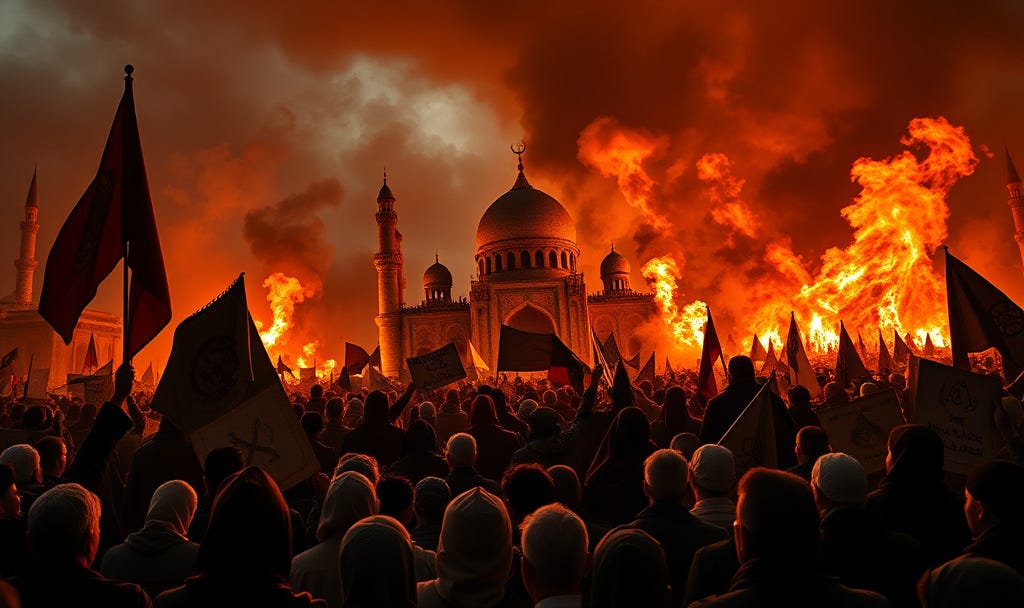
I have reached a grim point of resignation. Not despair, because despair is useless. Not surrender, because surrender is immoral. But resignation in the face of something so obvious, so visible, so repeatedly demonstrated by history, that one begins to suspect the problem is no longer ignorance. It is refusal. The Western mind, or at least the official Western mind, now seems determined to deny the danger until denial itself becomes impossible. Our institutions, our liberal elite, our media class, our intellectuals and our left-wing progressives are not merely asleep at the wheel. Many of them are gripping the wheel with both hands and steering us directly towards the cliff, while congratulating themselves on their compassion.
The danger is not Islam as private faith. It is not the quiet Muslim family living peacefully next door, working hard, raising children, obeying the law and wanting the same safety and dignity as everyone else. Any serious discussion must begin there, because decency requires truth and truth requires precision. The danger is Islamism: the political project that uses religion as a vehicle for power, intimidation, censorship, separatism and submission. It is the ideology that does not ask merely to worship freely, but to bend the public square around itself. It wants speech restricted, women disciplined, schools softened, police intimidated, politicians frightened, critics ruined and law made conditional upon offence.
This is the distinction the West is now too cowardly to make. It either smears all concern as bigotry or dissolves the entire problem into meaningless language about “community tensions” and “social cohesion.” The result is a civilisation that can still produce counter-terror reports, academic seminars and government strategies, but can no longer speak plainly to its own people. The truth is written in official documents and then denied in polite conversation. The state knows. The security services know. The police know. The public knows. Yet the respectable class behaves as though noticing the fire is more dangerous than the fire itself.
The formula is not new. It has been tried before. It has worked before. It begins with grievance, then victimhood, then demands. First recognition, then protection, then exemption, then special status. Criticism becomes hatred. Satire becomes danger. Blasphemy returns under new legal clothing. Women’s rights are negotiated in the name of sensitivity. Teachers learn to hesitate. Journalists learn to soften. Councillors learn which subjects end careers. Police commanders learn the language of avoidance. Judges discover elaborate ways to describe surrender as balance. Piece by piece, the host civilisation is trained to apologise for existing.
This is how nations are weakened now. Not usually by invasion, not at first, not in the old cinematic manner of flags, armies and broken gates. They are weakened by moral capture. They are weakened when the institutions of the state become more anxious about offending organised pressure groups than about betraying their own citizens. They are weakened when the majority is told that its instincts are hateful, its memory is dangerous, its culture is oppressive and its fear is illegitimate. A people can survive hardship, debt, war and scandal. What it cannot survive for long is being governed by elites who despise its right to notice reality.
Lebanon should have been the warning carved in stone. Iran should have been the warning written in blood. Again and again, we have seen what happens when a state loses confidence, when parallel loyalties harden, when religious-political movements acquire social power, when intimidation becomes a political instrument, when cowardice dresses itself as sophistication. Of course Europe will not repeat those histories exactly. History is never that lazy. But the pattern is recognisable. The instruments change, the slogans are updated, the language becomes progressive, therapeutic and bureaucratic, but the direction remains the same. Pressure. Concession. Silence. Fear. Control.
And now the pattern is visible across Europe, with only a few exceptions. The paradox is almost too dark to be believed: Brussels, the seat of European power, may be the most vulnerable of all. The city that imagines itself the administrative capital of the post-national world may become the first great symbol of post-national failure. Brussels is not merely a place. It is an idea. It is the polished glass cathedral of European liberal bureaucracy, a city of committees, directives, diplomatic receptions and soft-power self-confidence. Yet beneath that confident surface lies a fractured political order, a divided state, concentrated demographic pressure and an elite culture almost genetically incapable of defending a common civilisation.
If the first domino falls, it may not fall with gunfire. It may fall through paralysis. Brussels could become the model of institutional surrender: too fragmented to govern itself, too frightened to enforce one civic standard, too compromised to insist that all citizens live under one law. The danger there is not that ordinary Muslims exist in large numbers. The danger is that a weak and divided state may lack the will to confront those who organise politically, religiously and socially against the liberal order while hiding behind the language of minority protection. Brussels, symbolically and structurally, is the soft underbelly of Europe.
France is different. France has more iron in the blood. It still remembers the state. It still possesses a republican instinct, a secular vocabulary and a willingness, however inconsistent, to name separatism. But France is also closer to violence. The pressure there is sharper, the history heavier, the suburbs more combustible, the clash more explicit. France may not be the first to surrender, because it still has a hard state. But it may be the first to crack in the streets. The French conflict is not hidden. It is visible in the schools, the banlieues, the police lines, the slogans, the funerals, the silences and the fury of a nation that can feel the republic being tested.
Ireland, meanwhile, is showing the early signs of unrest. It is not France. It is not Belgium. It is not Britain. But the symptoms are beginning to rhyme. Public trust is thinning. Migration pressure, housing pressure, political evasion and cultural anxiety are combining into something volatile. When governments refuse to manage reality honestly, they do not produce harmony. They produce rage. And rage, once released into the street, is not easily controlled by the same politicians who helped create it. Ireland is not yet a warning of Islamism taking power. It is a warning of what happens when a people feel governed around, rather than governed for.
Then there is Britain, perhaps the most tragic case because it has all the tools and none of the courage. Britain has serious security services, experienced counter-terror structures, a deep legal inheritance and a public that is far more sensible than its rulers deserve. But culturally, politically and morally, Britain is in total denial. It is a country where the state can admit in its own counter-terror strategy that Islamist terrorism remains the principal domestic terrorist threat, while the public conversation still treats anyone who draws conclusions from that fact as socially suspect. Britain has not lost the ability to know the truth. It has lost the courage to say it aloud.
That is what makes the British condition so dangerous. We are not uninformed. We are over-managed. We are not protected from falsehood. We are protected from clarity. Every uncomfortable fact is wrapped in gauze, every pattern dissolved into complexity, every warning treated as a reputational hazard. The establishment has built an entire moral architecture around not noticing. It notices “far-right narratives” instantly. It notices “hate speech” instantly. It notices offence, tone, language, online comments and the emotional weather of activist groups with exquisite sensitivity. But when faced with organised Islamist pressure, it suddenly becomes nuanced, cautious, procedural and slow.
This is not tolerance. It is cowardice with a university degree. True tolerance requires a confident civilisation. It requires borders, law, reciprocity, civic equality and the courage to say no. A society that cannot say no is not tolerant; it is available. It is available to every pressure group, every imported grievance, every ideological coloniser and every fanatic who understands that Western elites can be manipulated by accusing them of the sins they already believe themselves guilty of. This is the fatal weakness of the progressive mind. It has been trained to believe the West is always the villain, so it instinctively sympathises with anyone who presents themselves as the West’s victim, even when that victimhood is used as a weapon.
The useful idiots will continue until something breaks. They always do. They will continue to aid, abet and deny, because to stop would mean confessing that they helped disarm the house while the arsonists were outside. They will call concern hatred. They will call surrender compassion. They will call intimidation sensitivity. They will call separatism diversity. They will call cowardice peace. And when the consequences arrive, as consequences always do, they will stand amid the rubble with the solemn expression of people who had no idea how such a thing could have happened.
But people did know. They warned. They warned about parallel societies. They warned about grooming gangs. They warned about blasphemy intimidation. They warned about extremist preaching, activist entryism, cowardly policing, captured councils, frightened schools and a media class more interested in managing perception than telling the truth. They warned that a civilisation cannot survive if it treats its defenders as extremists and its enemies as misunderstood. They warned that evil does not become harmless because it learns the language of rights.
The frightening thing is that the West may only awaken when the first nation visibly falls. Not metaphorically. Not in a think-piece sense. But visibly. A capital becomes ungovernable. A government loses control of districts. Police no longer enter certain spaces without political calculation. Teachers are abandoned. Writers are silenced. Women are told to accommodate. Jews leave. Christians lower their voices. Secular Muslims are intimidated. Critics require protection. Elections become ethnic censuses. Law becomes negotiable. At that point, the debate will be over, because reality will have entered the room carrying a knife.
And even then, the deniers will not apologise. They will revise. They will claim they always opposed extremism. They will insist they were only defending minorities. They will say nobody could have predicted the speed of events. They will blame austerity, colonialism, social media, inequality, housing, climate anxiety, masculinity, populism, or the far right. They will blame everything except the ideology they protected and the cowardice they practised. Their final act of denial will be to deny their own role in the denial.
I do not want to write this. I would rather be wrong. I would rather history make a fool of me. I would rather Brussels flourish, France calm, Ireland settle and Britain recover its voice without suffering the brutal education of catastrophe. But wanting does not alter the direction of travel. Civilisations are not saved by politeness. They are saved by truth, courage, law and the willingness to defend what is good before it is too late.
The West does not need to persecute anyone. It does not need cruelty, hysteria or collective suspicion. It needs moral seriousness. It needs one law. It needs honest speech. It needs borders that mean something, citizenship that means something, schools that defend civilisation rather than apologise for it, police who enforce the law without political trembling, and leaders who understand that peace is not maintained by surrendering inch by inch to those who despise peace.
Perhaps the first domino has not yet fallen. Perhaps there is still time. But time is no longer abundant. Across Europe, the air has changed. You can feel it in the hesitation of politicians, the anger of voters, the guarded speech of ordinary people, the nervousness of institutions and the growing arrogance of those who mistake Western restraint for weakness. The storm is no longer on the horizon. It is moving through the streets, the schools, the courts, the councils and the language itself.
And when the first Western nation falls to Islamism, the useful idiots will finally stop denying it. Not because they have found courage, but because denial will no longer be possible. By then, of course, they will have a new story ready. They always do.
As always Guy, a superb articulate piece. Thank you.
There is a paradox that a confident and secure culture can be tolerant of different cultures who can go about their business peacefully. An insecure culture that dislikes itself just invites other cultures to assert themselves and emphasise their own differences. The problem for now is that your analysis is correct but a large part of the country and a majority of those with power and influence do not see a problem that needs fixing. I don’t see anything changing very much unless and until the facts force a change of outlook - which will be vey painful.
A further problem - more kindling on the pyre - is the economy. A growing economy can bribe enough people to think things are getting better and assume that there are jobs to be done. A declining economy with fewer opportunities and fewer resources will bring out more conflict.